The Ministry of Information, Communications and the Digital Economy on Wednesday launched its five-year strategic plan, which seeks to deepen the sector’s role in the country’s economic development.
CS Eliud Owalo, while unveiling the plan in Nairobi, said the document will guide the ministry’s implementation of activities, projects and programmes in the period 2023-2027.
The plan is the culmination of concerted efforts by the ministry and key stakeholders in the ICT sector to ensure that priority programmes and projects in the Bottom-up Economic Transformation Agenda (BETA) are implemented as planned.
Here is the story in pictures:
KYEB CEO Lilian Kimeto (left) with managers Elijah Muli (Production) and Jane Mareka (Planning and Strategy) during the launch of the Ministry of Information, Communications and the Digital Economy Strategic Plan in Nairobi on Wednesday.
Eliud Owalo, CS of the Ministry of Information, Communications and The Digital Economy at the launch of the Ministry’s Strategic Plan.
KYEB Board director Jimmy Mauta at the event.
KYEB chairman Sande Oyolo (left)and ICTA CEO Stanley Kamanguya at the launch.
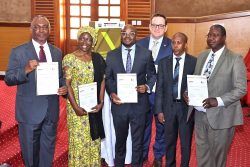
CS Eliud Owalo (left), PS Edward Kisiang’ani (second left), KYEB CEO Lilian Kimeto and Development Partner representative at the launch.
CS Eliud Owalo (sixth left), Broadcasting PS Edward Kisiang’ani (fifth left), and ICT PS John Tanui (seventh left) with development partners representatives, CEOs and senior officials during the event
KYEB Board director Mulei Muia, at the event.
Director KYEB, Kennedy Buhere at the launch.
CS Eliud Owalo (left), PS Broadcasting Eliud Kisiang’ani (second left), KYEB Chairperson Sande Oyolo (second right) and CEO ICTA Stanley Kamanguya (right) at the event.
KYEB Staff Humphrey Odanga at the event.
KYEB manager Susan Naitore at the event
KYEB Head of Internal Audit and Risk Assurance, Timothy Mwangi at the event.
Alice Mutua, KYEB Staff at the event.
KYEB’s managers Jane Mareka (Planning and Strategy) and Elijah Muli (Production).
KYEB Chair Sande Oyolo (left), ICT PS Eng. John Tanui (center) and Broadcasting PS Edward Kisiang’ani at the event.
CS Eliud Owalo (left), Broadcasting PS Edward Kisiang’ani (second right), and ICT PS John Tanui during the launch of the Ministry of Information, Communications and the Digital Economy Strategic Plan 2023-2027.
The Ministry of Information, Communications and the Digital Economy on Wednesday launched its five-year strategic plan, which seeks to deepen the sector’s role in the country’s economic development.
CS Eliud Owalo, while unveiling the plan in Nairobi, said the document will guide the ministry’s implementation of activities, projects and programmes in the period 2023-2027.
“This plan ensures that the ministry’s vision of an informed and digitally-empowered Kenyan society is aligned to the government’s transformative agenda, Vision 2030, Sustainable Development Goals (SDGs), Africa Agenda 2063 and other national government priorities,” the CS said.
The plan is the culmination of concerted efforts by the ministry and key stakeholders in the ICT sector to ensure that priority programmes and projects in the Bottom-up Economic Transformation Agenda (BETA) are implemented as planned, he added.
The document identifies seven key result areas namely policy, legal and institutional frameworks, digital superhighway and telecommunications infrastructure, digital government services and products, universal access to information, Business Process Outsourcing (BPO) and local content development, governance, finance and human capital development and cyber security, data governance and emerging technologies.
During the five-year period, the ministry said it would expand broadband connectivity, enhance e-government initiatives, expedite development of smart cities, intensify cybercrime and increase entrepreneurship in the technology industry.
The ministry will also foster digital literacy programmes, ensuring that Kenyan citizens have the necessary skills to participate in the digital economy, make e-commerce vibrant, deepen access to low-cost devices and universal access to information and internet services as envisaged in the constitution, Vision 2030, Medium Term Plans and the BETA.
Owalo said the ministry would also strengthen the Office of Data Protection Commissioner to ensure compliance with data protection laws and establish a centre to deal with cyber-crime.
Principal Secretary, Broadcasting and Telecommunication Edward Kisiang’ani said that main agenda of the strategic plan is to ensure that the government speaks in one voice, to serve the people and ultimately ensure its key institution achieve their goals.
“The policy in government is that we must help our national institutions to operate by adequately availing the required resources. We must protect national institutions and give space for the private sector to operate freely,” he said.
His ICT and the Digital Economy counterpart, Eng John Tanui, observed that the strategic plan prioritises the development of enabling infrastructure to ease the cost of doing business and expressed optimism in its success.
“I have no reservation that the Strategic Plan 2023-2027 will be a catalyst towards the future direction for the ICT sector, as well as spurring Economic Growth and Transformation,” the PS remarked.
CS Eliud Owalo (sixth left), Broadcasting PS Edward Kisiang’ani (fifth left), and ICT PS John Tanui (seventh left) with development partners representatives, CEOs and senior officials during the launch of the Ministry of Information, Communications and the Digital Economy Strategic Plan 2023-2027.
Present at the event were Communications Authority of Kenya Director-General David Mugonyi, Konza Technopolis CEO John Paul Okwiri, ICTA CEO Stanley Kamanguya, Kenya Yearbook Editorial Board (KYEB) CEO Lillian Kimeto, Kenya Institute of Mass Communication CEO Peter Wakoli, the chairman of the Universal Service Fund Advisory Council James Ongwae, KBC Ag. MD Paul Macharia, Media Council of Kenya CEO David Omwoyo and KYEB chairman Sande Oyolo, among other senior government officials and key stakeholders.
Government’s commitment to border security evident in new training programme
The border security programme launched recently seeks to better the management of the entry and exit points to strengthen the country’s national security.
The Principal Secretary for Internal Security and National Administration Raymond Omollo said the Border Management Programme would ensure the security and efficiency of all ports of entry and exit.
The programme encompasses critical dimensions of border management, including governance structures for cooperation and emerging trends and technologies.
“It is crucial to ensure that all border officers are equipped with the necessary knowledge and skills to effectively manage the complexities of border operations,” said PS Omollo.
The border management system coordinates domestic agencies in the country “as well as international coordination involving collaboration between neighbouring countries and trading partners to enhance security and promote economic and social cohesion”.
The PS said Kenya, through the programme, would have a more coordinated and efficient approach in tackling organised crime and other threats that undermine peace, security and sustainable development.
He underscored the link between security and development, and advocated for investments in administrative officers and local governance structures to bolster security at grassroots.
“Due to the intrinsic link between security and development, we seek support for the investment in our National Government Administrative Officers, who are pivotal in coordinating government policies and programmes at the grassroot level,” said the PS.
The Interior ministry has already laid the groundwork by reviewing the National Government Coordination Act, the Chiefs Act and the peacebuilding architecture to improve government service delivery.
According to Mr Omollo, another critical aspect of border security is the collaboration with development partners. Through strategic alliances with entities such as the European Union, the International Organisation for Migration and the United Nations Office on Drugs and Crime, Kenya has garnered support for training, technological advancements and infrastructure modernisation at border points. Development partners such as the World Bank and the United Nations Development Programme have played pivotal roles in fortifying Kenya’s resilience on border security.
The significance of international collaboration for enhanced security in the country was underscored by United Nations Resident Coordinator, Dr Stephen Jackson, who said there is interconnectedness between border security, peace and sustainable development, advocating for a comprehensive approach to addressing global challenges.
Kenya’s strategic location in East Africa underscores the importance of effective border management in enhancing trade, national security and promoting regional integration.
The country in January implemented a visa-free policy that allows anyone from across the world to get in after only applying for electronic authorisation. To stem threats of terrorism as well as organised crimes like human trafficking and money laundering, Kenya has over the years modernised its border operations.
Climate smart agriculture proving critical in reducing soil erosion in Taita Taveta
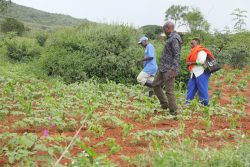
Obadiah Mjomba started farming maize, sorghum and green grams more than 10 years ago. “But as a farmer today, I can tell you that the weather is most unpredictable and low yields have negatively affected the community’s perception on agriculture,” he notes. Mjomba resides in Chawia Ward, Mwatate, Taita Taveta County, and is one among many farmers in the area who are affected by the adverse effects of climate change. Taita Taveta is considered an arid and semi-arid area despite the fact that it once was the breadbasket of the coastal region.
The decline in agricultural productivity is tied to environmental degradation due to climate change.
“We are using conservation agriculture, which is progressive and helps us retain soil structure,” he adds. He dug a hole during the recent heavy rains, and it filled with water.
“I got a donation of a dam liner from a local NGO, so it is a good reserve for water that I can use on my farm if I need to,” he states. Mjomba is preparing his land to plant cereals such as maize, sorghum, and pulses such as green grams and cowpeas for the upcoming season.
“I am also going to plant other crops such as tomatoes as I am not scared whether the rains fail or not,” he adds with great satisfaction.
He is looking forward to the more support from the county government which supports farmers, especially with proper investments in irrigation systems to reclaim the region’s former glory.
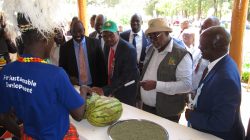
Agriculture CS Mithika Linturi (second left) engages a melon farmer at the Eldoret Show
One of the highlights of last week’s Eldoret ASK Show for farmer Simon Korir was learning how to produce his own livestock feeds using black soldier flies, an insect he had not heard about. Korir listened keenly as an exhibitor from Eldoret Technical Training Institute explained the process of housing, feeding and harvesting the black soldier flies larvae before drying to make livestock feeds.
“These flies are a good and cheaper source of proteins. Once you have them, you can mix with sources of carbohydrates and vitamins and end up with a composite meal,” said the exhibitor.
Farmers who attended the event also learnt the various urban farming techniques that include growing crops in worn out clothes and handbags, which ordinarily people dispose of.
New sheep, cattle and chicken breeds recently introduced in the country were also on display as well as fodder crops.
“Katambora grass gives higher yields and matures faster, therefore, it is climate-smart and can be used to make hay or silage before feeding to animals,” Elius Kipsang, an agronomist from Kenya Seed Company, explained to farmers.
Such is the knowledge that the farmers who attended the show went home with as they seek to transform their farming activities amid the rising effects of climate change.
Uasin Gishu Governor Jonathan Bii (right), samples an innovation at the University of Eldoret stand during the ongoing Eldoret ASK show.
The theme of the four-day show was “Promoting climate-smart agriculture and trade initiatives for sustainable economic growth”. With the use of the above innovative farming technologies, farmers can continue to produce food even as the effects of climate change hurt agriculture. These effects include erratic rains, frequent dry spells, increased pests and higher temperatures.
Addressing farmers at the event, President William Ruto asked them to embrace climate-smart farming practices so that they can continue to produce food despite the unfolding effects of climate change.
He noted that climate change is currently the single biggest threat to the country’s food security situation, therefore, farmers must adopt new practices.
The President said that the frequent heavy rains and dry spells are some of the effects of climate change, which have made it difficult for farmers to produce adequate food.
“We experienced El Nino rains last year. These rains destroyed crops on farms and also increased post-harvest losses,” President Ruto said in a speech read on his behalf by the Agriculture CS Mithika Linturi at the ASK Show.
To mitigate the effects of climate change, the President said the government is facilitating farmers to embrace new technologies and practices.
These include through provision of maize dryers and milk cooling equipment to stem post-harvest losses as well as the offering of resilient planting materials.
He further noted that the government has over the past months provided to farmers subsidised fertiliser to boost productivity, and, therefore, this season would not be different as the producers would receive the fertiliser on time.
Some 5.95 million bags of fertiliser were issued in 2023 to 995,000 farmers across the country.
“Agriculture has a high multiplier effect, that is why the government is investing in the sector to boost economic growth and create jobs,” he said.
During the 2023 season, the President said the country harvested over 60 million bags of maize, with the area under the crop increasing to 2.88 million hectares.
Provision of subsidised fertiliser, coupled with good rains, he noted, have made the country’s food security situation stable, with prices of various produce going down.
“A 2kg packet of maize flour is currently going at Sh130, a decline from Sh240 at the same time last year. These prices would further decline in the coming months,” he said. Mr Linturi asked dairy farmers to prepare for a new milk pricing regime, where they will be paid for quality and not quantity.
He further said the government would push for farmers to be paid in kilos to stop their exploitation.
Dr Jonathan Bii, Uasin Gishu Governor, said with the changing climatic conditions, farmers have no choice but to adopt new technologies and practices.
“We must embrace climate-smart farming techniques and innovations to continue to produce food despite climate change effects,” said Dr Bii noted that the county is among those worst hit by climate change, making it harder for farmers to know when to plant or harvest.
He said the county government has established climate-smart centre to promote sustainable farming practices.
“Our focus is on high-value crops like avocados and coffee. We have provided farmers with 29,000 avocado and over 100,000 coffee seedlings that are resilient,” he said, adding that the move is to prevent the reliance on maize.
Annabel Kirinya, the Agriculture Society of Kenya (ASK) chairperson, said the show that served as a curtain-raiser for ASK events had succeeded beyond their expectations.
“We are soon going to celebrate 100 years of ASK shows and this is a good start for us this year,” she said. Susan Seron, the chairperson of Eldoret ASK Show, said the event offered farmers a good platform to learn various new technologies and innovations, network and share experiences. Over 150 exhibitors participated in the show that was attended by hundreds of people.
Agriculture CS Mithika Linturi (second right) awards one of the winners at the Eldoret ASK Show on Friday. The show was used to promote climate smart technology.
President William Ruto on Friday asked farmers to embrace climate-smart farming practices so that they can continue to produce food despite the unfolding effects of climate change.
He noted that climate change is currently the single biggest threat to the country’s food security situation, therefore, farmers must adopt new practices.
The President said that the frequent heavy rains and dry spells are some of the effects of climate change, which have made it difficult for farmers to produce adequate food.
“We experienced El Nino rains last year. These rains destroyed crops on farms and also increased post-harvest losses,” President Ruto said in a speech read on his behalf by the Agriculture CS Mithika Linturi at the Eldoret ASK Show.
To mitigate the effects of climate change, the President said the government is facilitating farmers to embrace new technologies and practices.
These include through provision of maize dryers and milk cooling equipment to stem post-harvest losses as well as the offering of resilient planting materials.
He further noted that the government has over the past months provided to farmers subsidised fertiliser to boost productivity, and, therefore, this season would not be different as farmers would also receive the fertiliser on time.
Some 5.95 million bags of fertiliser were issued in 2023 to 995,000 farmers across the country.
“Agriculture has a high multiplier effect, that is why the government is investing in the sector to boost economic growth and create jobs,” he said.
During the 2023 season, the President said the country harvested over 60 million bags of maize, with the area under the crop increasing to 2.88 million hectares.
Provision of subsidised fertiliser, coupled with good rains, he noted, made the country’s food security situation stable, with prices of various produce going down.
“A 2kg packet of maize floor is currently going at Sh130, a decline from Sh240 at the same time last year. These prices would further decline in the coming months,” he said.
Mr Linturi asked dairy farmers to prepare for a new milk pricing regime, where they will be paid for quality and not quantity.
He further said the government would push for farmers to be paid in kilos to stop their exploitation.
The theme of the show, which ends on Saturday, was “Promoting climate-smart agriculture and trade initiatives for sustainable economic growth”.
Over 150 exhibitors participated in the show that was attended by thousands.
Uasin Gishu Governor Jonathan Bii (right) samples an innovation at the University of Eldoret stand during the ongoing Eldoret ASK Show.
Do you want to know the latest innovations in the agriculture sector? The Eldoret ASK Show is the place to be. The event, which started on Wednesday and ends on Saturday, is a hotbed of agricultural innovations that seek to boost farmers’ productivity amid the rapid climatic changes.
Among the innovations on display are new chicken, cattle, goats and sheep breeds, climate-resilient and high-yielding fodder, climate-smart farming techniques, post-harvest, value addition and urban farming technologies as well machines that can help farmers easily transport their produce to the market.
These technologies are in sync with the theme of the show, which is “Promoting climate-smart agriculture and trade initiatives for sustainable economic growth”.
The Kenya Yearbook Editorial Board (KYEB) team is at the event documenting these technologies and many others, which it will disseminate in its upcoming publications that include “AgendaKenya” and Agro-Innovations. Look out for them.
KYEB is also taking the opportunity to educate the public, including students, on Kenya’s past and present using its publications that include, The ”Yearbook”, “Towards Food Security” and “Moi Cabinets” which are a hit with showgoers.
Uasin Gishu Governor Jonathan Bii is among the dignitaries that attended Thursday’s session.
The governor thanked various exhibitors for taking their time to showcase their innovations and products at the trade fair.
He asked farmers to attend the show so that they can gain valuable insights that would enable them produce food in plenty despite the changing weather pattern.
The Editorial Board is using the event to engage the public and market itself at the grassroots.
The Eldoret ASK show kicked off in earnest on Wednesday, with hundreds of people attending the event that is one of the most important in the national agriculture calendar.
Kenya Yearbook Editorial Board (KYEB) is among the exhibitors at the event that runs until Saturday.
KYEB, which is mandated to produce the “Yearbook” in partnership with the people, is using the event to engage the public and market itself at the grassroots.
The institution is also creating synergies with other MDAs and collecting information for its various upcoming publications.
On the menu at the KYEB stand are its various publications namely “Towards Food Security”, “Yearbooks”, “Cabinet Series”, “KickOff”, “Toto Tales” and “Universal Health Coverage”.
Over 160 exhibitors are taking part in this year’s event, according to ASK officials.
President William Ruto is expected to officially open the show on Friday.
Deputy President Rigathi Gachagua when he hosted a delegation on the Kenya and Colombia technical cooperation on coffee value chain from Columbia at the official Residence in Karen, Nairobi on February 29, 2024. The delegation has been in the country for a five-day peer-to-peer review. The DP was joined Cabinet Secretary, Ministry of Cooperatives and Micro, Small and Medium Enterprises (MSMEs) Development Simon Chelugui, Colombian Ambassador to Kenya H.E Pedro Leon Cortes Ruiz, Chairperson of the National Assembly Committee on Agriculture and Livestock Dr. John Mutunga, and various stakeholders in the Coffee sub-sector. Photo | DPCS
Kenya and Colombia are blending their experiences in coffee production in a partnership that is expected to give the global market the best beans from each of the two countries. The two countries started the collaboration last September in what saw a delegation led by Deputy President Rigathi Gachagua visit the South American nation to pick lessons from their successes in coffee production.
Colombia is the third largest coffee producer in the world, after Brazil and Vietman, making it a perfect partner for Kenya whose production has been dwindling. The government further sent a number of farmers to the Cafes de Colombia Expo 2023 in October 19 in Bogota for lessons on coffee marketing, value addition and farming.
And in return, Kenya last week hosted a delegation from the Colombia National Federation of Coffee Growers, who visited several coffee factories and farms to familiarise with the country’s coffee industry. DP launches 53rd Huduma Centre They later held meetings with Mr Gachagua who announced that the two nations would sign agreements to facilitate knowledge-exchange on coffee farming and research.
Acknowledging that Colombia is a top global producer of high quality and premium coffee flavours, the DP said the two nations are preparing to strike a formula that will facilitate cooperation between Kenya’s Coffee Research Institute and its equivalent body in Colombia.
“The MoUs will create a framework for interventions that the government is deploying to restore the coffee sub-sector. Coffee farmers in Colombia are our big brothers.
The MoUs will be signed in the next three months,” he said. Mr Simon Chelugui, the Cabinet Secretary, Ministry of Cooperatives and Micro, Small and Medium Enterprises (MSMEs) Development, and Colombian Ambassador Pedro Leon Rui, said the visit cements the partnership between the two countries.
Mr Chelugui said through the partnership, Kenya is committed to increase its coffee production from the current 51,000 metric tonnes (MT) annually to 200,000MT by 2027. He said the government is keen to bring back the coffee glory that was in the 80s, where the cash crop was the leading foreign exchange earner. Production dwindled from a peak of 130,000MT in 1983/1984 to a low of 34,000 tonnes in 2020.
“This is an important milestone in cementing the relationship between Kenya and Colombia. We have been working together and our ties with Africa is a priority,” noted said Mr Rui. Among the places the Colambian delegation visited was the New Kenya Planters Coffee Union in Dandora, where they were taken through the process of milling, coffee cupping and cataloguing. Mr Carlos Armando Uribe, the director of Colombian-based Asuntos Gremiales Company, advised local farmers to increase the number of coffee trees per hectare from the current 3,000.
“Commitment and transparency are also needed as well government support. You also need to look for new markets in places like China, India and the United Arab Emirates,” he said.
Further, he called for enhanced participation of growers in elections of the sectoral leaders to boost “coffee democracy”. “We are a coffee-producing family. For our colleagues in Kenya, we can move together. The intention is for all of us to get better, and our families get better economically,” he stated.
Ms Wanjiku Wakogi, the Chief of Staff at the Office of the Deputy President, said the talks between the two nations are at the heart of Kenya’s economic development. “We are embarking on this wonderful chapter of cooperation between Kenya and Colombia, focused on our coffee value chains. This collaboration is not just a diplomatic gesture; it signifies a strategic partnership aimed at leveraging each other’s strengths for the mutual benefit of our coffee industries,” said Ms Wakogi.
Kilembwa secondary students have designed a robot that helps pick litter in school
For many schools across the country, the morning hours before classes start are set aside for cleaning and especially picking litter. It is an age-old practice that helps to instil a sense of responsibility in students and make the environment conscious.
However, this task can be time-wasting and it is for this reason that students of Kilembwa Secondary in Mwala, Machakos County, are coming with a robot that will help pick litter so that they can focus on their studies. The robot dubbed ‘lobster’ is supported by Kenya Connect (KC), a local NGO in conjunction with Future Investment Initiative (FII), a global nonprofit foundation. The two organisations partnered to provide the learners with laptops and robotic kits that were used to innovate the robot.
Mr Michael Muthama, a teacher at the school, said the availability of Information, Communication and Technology infrastructure in the school has increased the students’ interest in technological innovation.
“The computer lab has changed the attitude of learners in school and during computer class, the students are very keen,” said Muthama.
He said despite the school being located in a remote place, the students have an opportunity to innovate through the help of KC and FII. Muthama noted that the project will give the students vital ICT skills that will give them a competitive edge once they leave school. Maxwell Karanja, a form two student who aspires to be an aeronautical engineer, hailed the project saying it had given him a chance to learn ICT.
Karanja noted that once operational, the robot will save the students time spent on cleaning the school and instead focus on their studies. “When we come to school in the morning, we are supposed to clean the whole compound so the robot will help us clean as we focus on our studies in the morning,” said Karanja.
He added that the robot will help reduce the risk of infection among students since they pick litter with their bare hands. Karanja observed that the robot will have colour sensors which will be programmed using the computer and the robot will sense and pick the litters according to the colours programmed and dispose them to a dustbin.
The student further noted a computer will be programmed to monitor the robot’s movements around the compound as it senses and locates the litter. Kenya Connect is an NGO in Mwala Sub County whose aim is to engage and empower students and teachers to excel.